Showing posts with label SF. Show all posts

Saturday, April 24, 2010

[Y^^]: RoboCop (1987)

[Y^^]: RoboCop (1987)

The future of the movie is very gloomy. The capital control the city and police force.

Because financial difficulty of some cities such as LA, it may not be entirely fictional situation. The city is about to default on a debt. The fire fighters and police officers can not receive their salary. It's real.

Capitalism aims at making profits. People are forced to believe that the privatization is better because it's more efficent.

In the movie, the city, Detroit is governed by a company, OCP. The reason is familiar. Financial difficulty of regional government, privatization, M&A.

The company makes a plan to develop robots that substitute for police forces.

Murphy, a police officer was murdered in line of duty. Fortunately or unfortunately, he was reborn as cyborg. It's a great movie to express a bleak future dominated by the capitalism and efficiency. Also It says about beings between human and robots.


It's a very special movie to me, because I started to write something after watching this movie. The first fiction that I wrote was 'Neo Black(黑新敎).' It was affected by 'RoboCop' and 'The Legend of Condor Heroes(射鵰英雄傳).' Neo Black is a oriental fantasy novel. Robot police officiers, Taoist and vampires showed up. I wrote down on paper but I threw it away. I regret my action, but there is no Neo Black anymore.

Wednesday, April 14, 2010

RoboCop (1987)

RoboCop

Directed by: Paul Verhoeven
Starring: Peter Weller, Nancy Allen
Distributed by: Orion Pictures
Country: United States
Rating: MPAA: R (US), 15+ (KR)


RoboCop is a 1987 science fiction film directed by Paul Verhoeven. Set in a crime-ridden Detroit, Michigan in the near future, RoboCop centers on a police officer who is brutally murdered and subsequently re-created as a super-human cyborg known as "RoboCop". In addition to being an action film, RoboCop includes larger themes regarding the media, gentrification, corruption, and human nature. It has spawned merchandise, two sequels, three television series, a television mini-series, video games and two comic book adaptations.

The film features Peter Weller, Dan O'Herlihy, Kurtwood Smith, Nancy Allen, Miguel Ferrer and Ronny Cox.


Synopsis

In a dystopian future, the city of Detroit, Michigan is on the verge of collapse due to financial ruin and unchecked crime. The city brings in the mega-corporation Omni Consumer Products, or OCP, to solve the problems. OCP promptly privatizes the police force. OCP makes plans to destroy "Old Detroit" to replace it with the utopia of "Delta City."

The OCP Chairman (Dan O'Herlihy) recognizes that the human law enforcement is insufficient to stop the crime spree and seeks other opportunities. Senior President Dick Jones (Ronny Cox) offers a "law enforcement 'droid," the ED-209, but when the demonstration kills one of the other executives, the President of OCP turns instead to the "RoboCop" program to create an augmented cyborg, led by junior executive Bob Morton (Miguel Ferrer). Jones becomes bitterly jealous of Morton, as Bob Morton's accomplishment with Robocop allows him to move up on the ladder of success in the OCP ranks.

Veteran police officer Alexander James Murphy (Peter Weller) is transferred to a new precinct and partnered with Anne Lewis (Nancy Allen). On their first patrol, they chase down a team of criminals led by crime boss Clarence Boddicker (Kurtwood Smith) to an abandoned steel mill outside town. Murphy and Lewis separate, and Boddicker's men capture Murphy, sadistically murdering him by shooting him many times with shotguns before running off. Murphy is pronounced dead at the hospital, but OCP takes his body and uses it to create the first RoboCop. RoboCop is guided by three law enforcement tenets written into his programming, called Directives: serve the public trust, protect the innocent and uphold the law.

He is able to single-handedly deal with much of the violent crime in the city, causing the rest of the police force to become worried they may be replaced. However, RoboCop still retains memories of his life as Murphy, including brief glimpses of his wife and son, and the action of spinning his gun before holstering it, a trick Murphy had done for his son. Lewis recognizes these elements from Murphy's mannerisms, and tries to learn more from RoboCop, but he remains silent on the issues. Because of Robocop's success, Morton is promoted to become one of OCP's Vice Presidents.

Morton's success and arrogance leads Jones to have Boddicker, secretly in his employ, kill the junior executive. An armed gas station holdup by one of Boddicker's men allows RoboCop to track down Boddicker to a cocaine bunker. RoboCop bursts into the facility and a shootout between him and the bandits ensues. RoboCop then apprehends Boddicker and forcefully makes him reveal his alliance with Dick Jones. RoboCop then visits Jones at his offices at OCP, showing him Boddicker's statement and prepares to arrest Jones. However, as RoboCop does so, a previously unknown and secret fourth Directive activates that prevents RoboCop from acting against any senior executive of OCP. Jones boasts to RoboCop about the Fourth Directive, which he added, and his role in Morton's murder, and then sends an ED-209 against RoboCop. RoboCop, handicapped by his neural network, engages the machine. The ED-209, though possessing impressive advanced technology proves incapable of descending a stairway. When Robocop gets outside, the police SWAT team is waiting for him with orders to destroy him, but Lewis, having followed RoboCop, saves him.

Lewis tends to RoboCop's injuries at the same steel mill where Murphy was killed, and discovers that there is still some of Murphy present despite the cyborg augmentation. Meanwhile, the police launch their long-threatened strike, sending the city into chaos. Jones arranges for Boddicker and his men to be released from prison and funds them with new cars and Cobra Assault Cannons capable of puncturing RoboCop's heavy armor. Boddicker's team converges on the steel mill using a tracking device provided by OCP. RoboCop and Lewis defend themselves and kill the whole gang, though Lewis is severely wounded.

RoboCop returns to OCP headquarters and uses one of the Assault Cannons to destroy the ED-209 guarding the building. Arriving in the middle of an executive board meeting with the president, Jones, and other executives, RoboCop plays back Jones's confession to Morton's murder and explains his inability to arrest OCP employees. Jones quickly grabs a gun and takes the president hostage and begins making demands. The president, in response to being taken hostage and enlightened by RoboCop's explanation of the Fourth Directive, fires Jones, invalidating his protection under it. After thanking the president, RoboCop promptly shoots Jones, who then falls out of the window to his death. As the board room recovers from the crisis, the president commends RoboCop for his skill and asks for his name, to which he replies, "Murphy".


Monday, March 8, 2010

Najica Blitz Tactics

Najica Blitz Tactics

Alternative Title(s):
Najica, Najica Dengeki Sakusen, Najica missions éclair, 나지카 전격작전

Genre: Action, Adventure, Science Fiction, Comedy, Shoujo, Shounen
Studio: Studio Fantasia

Najica Blitz Tactics (ナジカ電撃作戦 Najika Dengeki Sakusen) is an anime television series by Studio Fantasia. It premiered across Japan between October 4, 2001 and December 27, 2001. The show is similar to that of Agent Aika—both being directed by Katsuhiko Nishijima and animated by Studio Fantasia—with much of the same content.

Though Najica was later adapted into a manga by Takuya Tashiro (田代 琢也 Tashiro Takuya), the majority of the difference in content were in the context of the missions and especially the ending.


Story

Najica Hiiragi is a noted perfumer for CRI Cosmetics, famous for being able to identify over 500 scents. As the series began, she is struggling to finish "The Day Series" (a series of scents modeled after the days of the week), trying to find the perfect scent for the final perfume, "Sunday".

Secretly however, Najica is actually a field agent for CRI's Intelligence Bureau, an agency unknown to the public (and even to most of its own employees for the sake of their own protection). She is an expert markswoman with her preferred weapon; the Stechkin APS, an old Russian firearm with selective fire (auto and semi-auto) and a wooden holster that doubles as a shoulder stock. The twenty round magazine is loaded with non-lethal plastic bullets.

Najica is also an expert helicopter pilot, and she has a custom-modified Mil Mi-35 Hind assault helicopter with remote control and advanced avionics.
Najica's first mission in the narrative is to recover a Humaritt (android) codenamed "ZZZ" and referred to as "Lila", Najica becomes suspicious when CRI Intelligence is contracted by Shinba Industrial to recover more lost and possibly rogue Humaritts; especially since most of them are in the hands of criminals, revolutionaries, guerillas or terrorist groups. Her suspicions increase when Lila is assigned to be her partner, even though Najica insists she be allowed to continue working alone. As time goes on however, Najica begins to trust Lila, even if Lila's lack of social graces make her wince. Soon however the two's bond is tested when they face the creator of the Humaritts and her ultimate plan...

http://en.wikipedia.org/wiki/Najica_Blitz_Tactics


Anime series | Manga series | Action anime and manga | Adventure anime and manga | ADV Films | Anime of 2001 | Ecchi anime and manga | Manga of 2002 | Science fiction anime and manga

Wednesday, March 3, 2010

Future Boy Conan (未来少年コナン, Mirai Shōnen Konan)

Future Boy Conan (未来少年コナン, Mirai Shōnen Konan)

TV anime
Director: Hayao Miyazaki
Studio: Nippon Animation
Original run: April 4, 1978 – October 31, 1978

Anime film: Mirai Shōnen Conan Tokubetsu Hen-Kyodaiki Gigant no Fukkatsu
Director: Hayao Miyazaki
Studio: Nippon Animation
Released: March 11, 1984
Runtime: 25 minutes


Future Boy Conan (未来少年コナン, Mirai Shōnen Konan) is an anime series, which premiered across Japan on the NHK network between April 4 and October 31, 1978 on the Tuesday 19:30-20:00 timeslot. The official English title used by Nippon Animation is Conan, The Boy in Future.

Spanning a total of 26 episodes, the series was produced by Nippon Animation and featured the likes of Hayao Miyazaki (director, character designs, storyboards), Isao Takahata (storyboards) and Yoshiyuki Tomino (storyboards). It is an adaptation of Alexander Key's novel The Incredible Tide.

A video game version of the series by Telenet Japan was released in 1992 on NEC's PC Engine console. The game was released on the Super CD-Rom format and was only available in Japan.


Story

The story begins in July 2008, during a time when mankind is faced with the threat of extinction. A devastating war fought between two major nations with ultra-magnetic weapons far greater than anything seen earlier brings about total chaos and destruction throughout the world, resulting in several earthquakes and tidal waves, the earth thrown off its axis, its crust being rocked by massive movements, and the five continents being torn completely apart and sinking deep below the sea.

An attempt by a group of people to flee to outer space failed, with their spaceships being forced back to earth and vanishing, thus shattering their hopes. But one of the spaceships narrowly escaped destruction and crash landed on a small island which had miraculously survived the devastation. The crew members of the spaceship settled there, as if they were seeds sown on the island.

Amidst these survivors, a boy named Conan was born, bringing a new ray of hope to the earth. After several years, during which most of the other survivors had died and the only people left on the island were Conan and his grandfather, he meets a young girl named Lana, and their adventure begins.

Between the different islands left in the world: Industria, High Harbor, Rambent, and others, the group travel and conflict rises between good and evil.


Characters

Conan (コナン Konan) Seiyū: Noriko Ohara
The main protagonist of the series, Conan, is an 11 year old boy who grew up on the island and was raised by his grandfather. Conan is very strong, and can even hang from a ledge using only his toes. Conan is friends with Lana.

Lana (ラナ Rana) Seiyū: Mieko Nobusawa
Lana is the first non-Remnant Island inhabitant, and the first girl Conan sees. Lana is the granddaughter of Dr. Lao, and Lepka wants to use her to get Lao to tell him the secret of solar power. Lana is referred to as possessing ESP, allowing her to communicate with a seagull 'Tikki', as well as sense the presence of her grandpa. She comes from High Harbour.

Grandpa (おじい Ojī) Seiyū: Masato Yamanouchi
Conan's elderly grandfather, who's alive after their spaceship crashes on the remnant island in the first episode.

Monsley (モンスリー Monsurī) Seiyū: Rihoko Yoshida
A young commander of Industria's armed forces, Monsley is the second non-Islander Conan sees. Piloting the flying boat Falco, she follows Lepka's orders by helping capture Lana, and eventually leading the invasion of Industria to conquer the High Habor. Ultimately after the lost battle in the High Harbor, Monsley renounces Lepka's ambitions, and joins with Conan against him.

Jimsy (ジムシー Jimushī) Seiyū: Kazuyo Aoki
A wild boy living alone on the first island Conan arrives at, Jimsy quickly becomes Conan's first 'companion', helping him rescue Lana. Jimsy is a master hunter, and motivated by his stomach.

Dyce (ダイス Daisu) Seiyū: Ichirō Nagai
Dyce is a citizen of Industria, and the captain of the ship Barracuda. He was ordered to kidnap Lana prior to the start of series, but let her escape due to his obsession with his captive. Dyce is initially a comedic villain in the show, but eventually becomes one of Conan's allies .

Lepka (レプカ Repuka?) Seiyū: Iemasa Kayumi
The head of administration of Industria, Lepka technically serves under the Industria High Council, a group of scientists. However, over the course of the series, he becomes the sole dictator of Industria, and the primary antagonist. Lepka desires to extract the secret of solar power from Lao to power his weapons, allowing him to rule over what remains of the world.

Dr. Lao (ラオ博士 Rao-hakase) Seiyū: Masato Yamanouchi
The grandfather of Lana, the main scientist responsible for the development of solar power for both civil and wartime usage. Originally a member of the Industrian High Council, he defected after he learned of Lepka's ambitions. He believes that the people of Industria must be taught to discard their weapons, and begin new lives. For this reason he escapes, bringing with him the secret of how to access the orbiting solar power station from pre-war times.

Umasou
Umasou is Jimsy's piglet, "unmasou" which means "Look Delicious" in Japan.

Orlo
The coward and the traitor of the High Harbor, he follows the Industria and has an evil plot to become a leader of High Habor then he gives a demand to everyone to give up Industria.

Tera
Orlo's younger sister, she's injured by a rocket from Industria's soldiers and is the second leader of Orlo's men.


Anime

Future Boy Conan first aired across Japan on the NHK TV network between April 4 and October 31, 1978, during the Tuesday, 7:30pm timeslot. It has been regularly broadcast across Japan on the anime satellite television network, Animax, who have also later translated and dubbed the series into English for broadcast across its respective English-language networks in Southeast Asia and South Asia, under the title Conan, The Boy In Future.

The series was also translated into numerous other languages, including Cantonese, Mandarin, French, Spanish, Italian, Catalan, Basque, Portuguese, Korean, Turkish and Arabic, being broadcast across Europe, Latin America, the Arab World, and numerous other regions.

http://en.wikipedia.org/wiki/Future_Boy_Conan


Anime series | Anime films | Nippon Animation | Future Boy Conan | Adventure anime and manga | Drama anime and manga | Science fiction anime and manga | Anime of 1978 | Anime of 1984 | Bandai Visual | 1978 television series debuts | Steampunk anime and manga | Steampunk television series

Friday, April 3, 2009

Basquash! (2009)

Basquash!

Alternative names: バスカッシュ!, Basukasshu!
Genre: Science Fiction, SF, Sports, Mecha, Real Robot

TV anime
Director: Shin Itagaki, Shoji Kawamori (Project Director)
Writer: Tatsuo Satoh (Series Composition), Yuuko Kakihara, Yuki Enatsu
Studio: Satelight
Network: MBS
Original run: April 3, 2009 – October 1, 2009
Episodes: 26

Manga
Author: Tetsuya Hayashi
Publisher: Kadokawa Shoten
Demographic: Shōnen
Magazine: Shōnen Ace
Original run: January 26, 2009 – September 26, 2009
Volumes: 2

Manga: Basquash! Eclipse Stage
Author: Kagemaru
Publisher: Kadokawa Shoten
Demographic: Seinen
Magazine: Comp Ace
Original run: April 25, 2009 – September 26, 2009
Volumes: 1


Basquash! (バスカッシュ! Basukasshu!) is a sports and sci-fi anime which aired on Mainichi Broadcasting System. It involves characters playing basketball while riding mecha. The series premise was created by Thomas Romain and Shoji Kawamori, with the animation produced by Satelight. Shoji Kawamori is handling the project direction, while the series direction will be done by Shin Itagaki. On July 10, 2009 it was reported that director Shin Itagaki was to be replaced by another, as yet, unnamed director starting from the eleventh episode. The series will be adapted as a remake but targeted for kids and sport fans. Anime News Network. March 25, 2010.


Plot

The story takes place in the world of "Earth Dash", an alternate, futuristic version of Earth where human society split between the far more advanced lunar society and that of the planet's surface. A popular sport is BFB (Big Foot Basketball), where players ride mecha called "Big Foot" and play basketball in a giant arena. In the city of Rolling Town, Dan JD and his companions take the sport to the streets, rename it "Basquash", and then embark on a journey to overcome their past hardships and make their dreams come true.


http://en.wikipedia.org/wiki/Basquash


Anime series | Manga series | Anime of 2009 | Basketball anime and manga

Thursday, July 3, 2008

[Y^^]: Hancock (2008)

[Y^^]: Hancock(2008)

Studio: Overbrook Entertainment, Weed Road Pictures, Blue Light Productions, Relativity Media
Distributed by: Columbia Pictures
Release date(s): July 3, 2008 (United States)


Wanted(2008) and Hancock(2008). They are different genre and style. However, they have have something in common. Both of them are unconventional. They tried something new.
Someone may say Hancock is not so new, but Hancock is different from the other heroes who familiar with us.

He has superhuman power, but he is not a perfect hero. He is also different from the heroes who are tormented by mental suffering.

Hancock has physical power, but he is not a hero nor a villain. His intention to catch thiefs does not justify his actions. The citizens blame him and he is sent to jail.

Step by step, he becomes the hero who we are familiar with.

When they say that they are named as heroes, angels or gods, it seems contrived. Except that it's delightful film.


Tuesday, April 8, 2008

Burn Up W (バーンナップW)

Burn Up W

Genre: Comedy, Science Fiction, Seinen

TV anime
Director: Hiroshi Negishi
Studio: AIC
Original run: April 10, 1996 – September 26, 1996


Burn Up W (バーンナップW. Bānnappu W) is an anime OVA directed by Hiroshi Negishi and released in 1996. It was soon followed by a series version called Burn Up Excess though it occasionally lacks continuity with the series. The OVA consists of four episodes, chronicling Team Warrior through more missions. Like the original series, there is still a large amount of fan service.


http://en.wikipedia.org/wiki/Burn_Up_W


Anime series | Action anime and manga | ADV Films | Comedy anime and manga | Science fiction anime and manga | Anime of 1996 | Anime distributed by Madman Entertainment

Tuesday, October 16, 2001

Smallville (2001-)

Smallville

GenreAction, Adventure, Science fiction, Drama
Created byCharacters: Jerry Siegel, Joe Shuster
Developed byAlfred Gough, Miles Millar
Opening theme"Save Me" by Remy Zero
Composer(s)Mark Snow, Louis Febre
Country of originUnited States
Language(s)English


Smallville is an American television series developed by writers/producers Alfred Gough and Miles Millar, based on the DC Comics character Superman created by Jerry Siegel and Joe Shuster. The television series was initially broadcast by The WB, premiering on October 16, 2001. After its fifth season, The WB and UPN merged to form The CW, which is the current broadcaster for the show in the United States. The longest-running comic book based series in television history, Smallville began its ninth season on September 25, 2009, and was renewed for its tenth and final season on March 4, 2010. The series follows the adventures of Clark Kent (Tom Welling), who resides in the fictional town of Smallville, Kansas, during the years before he becomes Superman. The first four seasons focused on Clark and his friends' high school years. Since season five, the show has ventured into more adult settings, eventually focusing on his career at the Daily Planet, as well as introducing other DC comic book superheroes and villains.

The concept for Smallville was derived after a potential series chronicling a young Bruce Wayne's journey toward becoming Batman failed to get off the ground. After meeting with the president of Warner Bros. Television, Gough and Millar pitched their "no tights, no flights" rule, which would break Superman down to the bare essentials and look at the events that led Clark Kent to become Superman. After seven seasons with the show, series developers Gough and Millar departed without providing a specific reason. Smallville is predominantly filmed in and around Vancouver, with some of the local businesses and buildings substituting for Smallville locations. The music for the first six seasons is primarily composed by Mark Snow, who incorporates elements of John Williams's musical score from the original Superman film series. In season seven, Louis Febre—who had worked with Snow from the beginning—took over as primary composer. The song played under the opening titles is "Save Me" by Remy Zero; several episodes also contain songs written and performed by other bands.

The series received generally positive reception when it began broadcasting. Former Superman star Christopher Reeve voiced his approval of the series, and the pilot episode broke the record for highest rated debut for The WB, with 8.4 million viewers. With nine seasons completed, Smallville has averaged approximately 4.47 million viewers per episode, with season two averaging the highest ratings at 6.3 million.


Series overview

Season one sees the introduction of the regular cast, and storylines which regularly included a villain deriving a power from kryptonite exposure; the one-episode villains were a plot device developed by Gough and Millar. The first season primarily dealt with Clark trying to come to terms with his alien origins, and the revelation that his arrival on Earth was connected to the deaths of Lana's parents. After the first season, the series used fewer villain-of-the-week episodes, focusing more on story arcs which affected each character and explore Clark's origins. Main story arcs include: Clark's discovery of his Kryptonian heritage; the disembodied voice of Clark's biological father Jor-El is introduced, communicating to Clark via his space ship, setting the stage for plots involving the fulfillment of Clark's earthly destiny; Clark seeking out three Kryptonian stones, at the instruction of Jor-El, which contain the knowledge of the universe and form his Fortress of Solitude; Clark battling Brainiac in his attempts to release the Kryptonian criminal General Zod; other escaped Phantom Zone criminals Clark must either capture or destroy; the arrival of Clark's biological cousin Kara; and Lex finally discovering Clark's secret. The eighth season features storylines involving the introduction of Davis Bloome, who is Smallville's interpretation of Doomsday, and a woman named Tess Mercer to replace the exit of Lex Luthor from the series. Justin Hartley reprises his role as Oliver Queen/Green Arrow, being upgraded to a series regular. With the ninth season, "Major" Zod (Callum Blue), along with other members of Zod's military group, are revived by Tess Mercer, though without their Kryptonian powers. Their efforts to obtain those powers becomes the central conflict for the season's story arc.


http://en.wikipedia.org/wiki/Smallville


Superman | CW network shows | WB network shows | Fantasy television series | Smallville | Television shows set in Kansas | 2001 American television series debuts | Television series by Warner Bros. Television | 2000s American television series | 2010s American television series | Teen dramas | Superhero television programs | Superman television series | Serial drama television series | Television series produced in Vancouver

Wednesday, February 14, 2001

Chobits (2001~2002)

Chobits (2001~2002)

Alternative names: ちょびっツ, Chobittsu
Genre: Romantic comedy, Science Fiction, SF

Manga
Author: Clamp
Publisher: Kodansha
English publisher: Madman Entertainment, Tokyopop, Dark Horse Manga
Demographic: Seinen
Magazine: Young Magazine
Original run: 14 February 2001 – 29 November 2002
Volumes: 8

TV anime
Director: Morio Asaka
Studio: Madhouse
Licensor: Madman Entertainment, Geneon (2003-2007), Funimation Entertainment (2011), MVM Films, ADV Films, MC Entertainment
Network: Animax, TBS, BS-I
English network: Animax Asia, Anime Network
Original run: 2 April 2002 – 24 September 2002
Episodes: 26


Chobits (ちょびっツ, Chobittsu) is a Japanese manga created by the Japanese manga collective Clamp. It was published by Kodansha in Young Magazine from February 2001 to November 2002 and collected in eight bound volumes. Unlike most stories by Clamp, Chobits is a seinen series commonly mistaken for shōjo because of its strong romantic themes and flowery art style.[citation needed] Chobits was adapted as a 26-episode-long anime television series broadcast on TBS and Animax from April to September 2002. In addition, it has spawned a video game as well as various merchandise such as figurines, collectable cards, calendars, and artbooks.

The series tells the story of Hideki Motosuwa, who finds an abandoned persocom (パソコン, PasoKon), or personal computer (パーソナルコンピュータ pāsonaru konpyūta) with human form, that he names "Chi" after the only word it initially can speak. As the series progresses, they explore the mysteries of Chi's origin together and questions about the relationship between human beings and persocoms. The manga is set in the same universe as Angelic Layer, taking place a few years after the events of that story, and like Angelic Layer, it explores the relationship between human beings and electronic devices shaped like human beings. Chobits branches off as a crossover into many other stories in different ways, such as Tsubasa: Reservoir Chronicle, xxxHolic and Kobato.


Plot

Story

The series centers on the life of Hideki Motosuwa, a held-back student attempting to qualify for university by studying at Seki prep school in Tokyo. Besides a girlfriend, he dreams of having a persocom (パソコン): an android used as a personal computer, which is expensive. On his way home one evening, he stumbles across a persocom in the form of a beautiful girl with long hair lying against a pile of trash bags, and he carries her home. Upon turning her on, she instantly regards Hideki with adoration. The only word the persocom seems capable of saying is "chi" (ちぃ, Chii), thus he names her that. Hideki assumes that there must be something wrong with her, and so the following morning he has his neighbor Hiromu Shinbo analyze her with his mobile persocom Sumomo. After Sumomo crashes during the attempt they conclude that she must be custom-built.

Shinbo introduces Hideki to Minoru Kokubunji, a twelve-year-old prodigy who specializes in the field of custom-built persocoms. Minoru's persocoms, including Yuzuki, a fairly exceptional custom-built persocom, are not able to analyze Chi either, and thus they conclude that she may be one of the Chobits, a legendary series of persocoms rumoured to have free will and emotions. Although this is a possibility, Minoru is confident that it is only rumour. Yuzuki also adds that she does not resemble any persocom model in any available database and so she must be custom made after all.

A major part of the plot involves Hideki attempting to teach Chi words, concepts, and appropriate behaviours, in between his crammed schedule of school and work. At the same time, Chi seems to be developing feelings for Hideki, at an emotional depth she is not supposed to possess, and Hideki struggles with his feelings for her. The need to figure out more about Chi and her mysterious functions and past becomes a pull for the characters in the series.

Hideki's feelings intensify for Chi whether she is a persocom or not, despite horrible experiences of his friends involving persocoms. Chi becomes aware of her purpose through a picture book series called A City with No People which she finds in a bookstore. The books speak about many different things involving human and persocom relationships: persocoms and their convenience as friends and lovers, how there are things that they cannot do and questioning whether a relationship between a persocom and a human is really one-sided. It also speaks about the Chobits series; that they are different from other persocoms, and what they are incapable doing unlike other persocoms. These picture books awaken Chi's other self, her sibling Freya who is aware of their past and helps Chi realize what she must do when she decides who her "person just for me" is. Together, Chi and Hideki explore the relationship between human beings and persocoms, as well as their friends' and their own.


http://en.wikipedia.org/wiki/Chobits


Manga series | Anime series | 2002 television series debuts | 2002 television series endings | ADV Films | Anime of 2002 | Clamp (manga artists) | Chobits | Drama anime and manga | Ecchi anime and manga | Geneon | Madhouse | Anime distributed by Madman Entertainment | Manga distributed by Madman Entertainment | Manga of 2001 | Romantic comedy anime and manga | Science fiction anime and manga | Seinen manga | Tokyopop titles | Funimation Entertainment

Monday, July 5, 1999

Amazing Nurse Nanako (1999)

Amazing Nurse Nanako

Alternative names: Amazing Nurse Nanako, 菜々子解体診書, Nanako Kaitai Shinsho
Genre: Comedy

Original video animation
Director: Hiroshi Negishi
Studio: Radix
Licensor: Save Our Nurse Project, Geneon
Released: 5 July 1999
Episodes: 6


Amazing Nurse Nanako (菜々子解体診書 Nanako Kaitai Shinsho) is an anime OVA series released in Japan. There were 6 episodes. It was released in January 2003 in a DVD box-set in the United States through Geneon. It combines humor, science-fiction and ecchi.

The series details the life and history of Nanako Shichigusa, a 16-year-old who works as a maid (not nurse as the title might imply) in the hospital of Dr. Kyogi Ogami, the male lead. Nanako is a classic ditzy slapstick protagonist who tends to accidentally break things and do everything wrong. Ogami treats her frequently in a cruel or heartless manner -- threatening her, yelling at her and even subjecting her to physical abuse -- yet at the climax of every episode he comes through to rescue her from whatever predicament she got herself into. Much of the series revolves around the relationship between Nanako and Ogami -- his mean veneer, her faith in him, and how he alternates between the evil mad scientist archetype and the knight in shining armor archetype.

As the series progresses we are gradually revealed the history between Nanako and Ogami's family and given a reason why the two are so tightly knit together, as well as why the title refers to Nanako as a "nurse". A minor supporting cast is introduced, though Nanako and Ogami are clearly the leads. The plot incorporates the American military, the Catholic Church and outlandish science fiction experiments, with these elements progressed mostly in the lead episode and the last two episodes. The middle episodes 2-4 feature mostly unrelated one-shot plots, though minor progress is made in each episode regarding the history between Nanako and Ogami's family.


Plot summary

In the beginning, Nanako was the subject of a cyborg experiment conducted by Dr. Ogami for one of his most powerful robots. Through rigorous training, Dr. Ogami trained Nanako to withstand the pain. However, he made her too strong, and the plan ultimately failed. However, recent developments between the Pentagon and the Vatican to resurrect Jesus for the Second Coming have landed Nanako as the subject of an operation in which she will give birth to the new Jesus.

Throughout the series, we learn that Nanako is, in fact, the third clone in a series of clones cloned from the original Nanako. The original died from a mysterious illness, and an experiment to clone her was successful. However, around the age of 20, each Nanako clone dies of the same mysterious illness that claimed the life of the first Nanako. It has been Dr. Ogami's quest to cure the "Nanako illness" ever since he promised the second clone that he would heal her before she died when he was young.


http://en.wikipedia.org/wiki/Amazing_Nurse_Nanako


Anime OVAs | Anime of 1999 | Anime series | Comedy anime and manga | Ecchi anime and manga | Fictional nurses | Geneon | Science fiction anime and manga

Saturday, November 18, 1995

[Y^^]: Ghost in the Shell (1995)

[Y^^]: Ghost in the Shell (1995)

Genre: Science fiction, Cyberpunk

Anime film
Director: Mamoru Oshii
Writer: Kazunori Itō
Composer: Kenji Kawai
Studio: Production I.G
Released: November 18, 1995 (Japan), December 8, 1995 (United Kingdom), March 29, 1996 (United States)
Runtime: 80 minutes


Whether you like Japan or not, Japan is on another level. I think that when I watch the Japanese animation (anime) or read comics (manga). Some anime and manga include deep contemplation of the meaning of life, but they are not boring at all. If you do not want complicated thought, it will be good. You can just watch or read just for fun. The anime and manga are interesting in themselves. If you want philosophical speculation, it will be better. You can think the depth of life with them.

Of course, not every anime and manga is like that. One of that kind of animes is Ghost in the Shell. It's high quality science fiction animation. You may be satisfied with the story and composition. Moreover, it contains the question of 'life and death', and 'body and soul'.

The Ghost in the Shell does not give the answer because no one can give the answer except God. Instead, it gives an opportunity to think about that through the exciting screen.

By the way, I have no idea why women wear the optical camouflage fatigues under their underwears, and men wear the optical camouflage fatigues over their garments.

Sunday, March 4, 1984

Nausicaä of the Valley of the Wind (1984)

Nausicaä of the Valley of the Wind (1984)

Alternative titles:
風の谷のナウシカ, Kaze no Tani no Naushika, Warriors of the Wind

Directed by: Hayao Miyazaki
Studio: Topcraft
Distributed by: Toei Company
Release date(s): March 4, 1984 (Japan), June 1985 (Warriors of the Wind, North America), February 22, 2005 (uncut re-release, North America)
Rating: MPAA: PG (Parental Guidance Suggested)


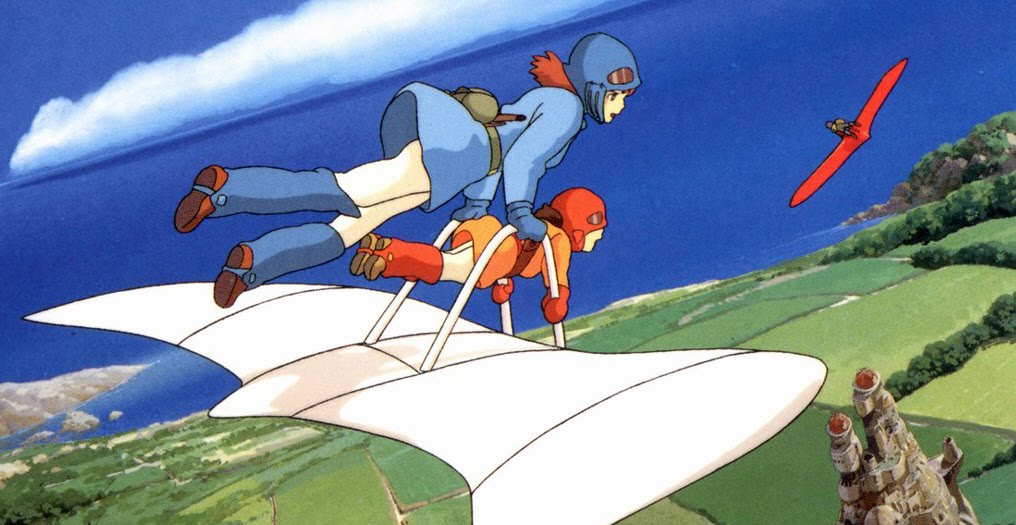
Nausicaä of the Valley of the Wind (風の谷のナウシカ, Kaze no Tani no Naushika) is a 1984 post-apocalyptic Japanese anime film, written and directed by Hayao Miyazaki, based on his manga of the same name. The film has environmentalist undertones and was presented by the World Wide Fund for Nature when it was released in 1984. While created before Studio Ghibli was founded, the film is considered to be the beginning of the studio, and is often included as part of the Studio's works, including the Studio Ghibli Collection DVDs. Among its numerous awards, it won the Animage Anime Grand Prix prize in 1984.


Plot

The story takes place 1,000 years after the "Seven Days of Fire", an event which destroyed human civilization and most of the Earth's original ecosystem. Scattered human settlements survive, isolated from one another by the Toxic jungle, a forest of giant plants and fungi swarming with giant insects, which seem to come together only to wage war. Everything in the Toxic Jungle including the air is lethally toxic.

Nausicaä is a charismatic young princess of the peaceful Valley of the Wind. Although a skillful fighter, Nausicaä is humane and peace-loving. She has an unusual gift for communicating with the giant insects (particularly with the Ohmu, gigantic, armored, caterpillar- or isopod-like insects who are the most intelligent creatures in the Toxic Jungle.) She is also noted for her empathy toward animals, humans, and other beings. An intelligent girl, and inspired by the Valley's Lord Yupa, a wandering warrior possessed of great wisdom, Nausicaä frequently explores the Toxic Jungle and conducts scientific experiments in an attempt to define the true nature and origins of the toxic world in which she lives. Her explorations are facilitated by her skill at "windriding": flying with an advanced jet assisted glider craft. Yupa is searching for the mythological man in blue who, according to the legend, will appear surrounded by a sea of gold and reunite the people and nature.

One day, an airship crashes onto the cliffs near the Valley of the Wind. Nausicaä tries to rescue a shackled girl of her age from the burning wreck, but the girl dies after revealing that she is Princess Lastelle from the kingdom Pejite and that the cargo of the airship must be destroyed. The airship is from Tolmekia and the cargo turns out to be the embryo of a Giant Warrior, one of the lethal, giant creatures used in the ancient war.
It is later revealed that the Warrior embryo was unearthed by Pejite, but it was stolen by the more powerful state of Tolmekia. While transporting the Warrior - along with Lastelle as a hostage - back to their realm, the Tolmekians were attacked by insects and later crash-landed in the Valley. The next day, the Tolmekians, under the leadership of princess Kushana, invade the Valley to kill the Valley king and to secure and revive the Warrior. Kushana explains that the Giant Warrior will be used to burn the Toxic Jungle even though Obaba, a blind elder Valley woman, warns that attempting that will only anger the Ohmu and lead to more deaths and turn the valley into part of the jungle.

Kushana attempts to return to Tolmekia, with Nausicaä and several others as hostages. Before their departure, Nausicaä reveals to Yupa a hidden garden of jungle plants which are not toxic because they are growing in sand and water from a deep, untainted well. Nausicaä explains that the jungle is only toxic due to the toxic soil that covers the surface of the earth, even in the Valley; she has been trying to find the cause and a possible cure for her people, including her now-dead father. Since she has to depart, however, she has shut down the water flows which keep the plants alive.

The airships are attacked by a Pejitan gunship and several of the ships are destroyed. Nausicaä and another hostage, on board of one of the burning cargo ships still mid-air, make their way to a gunship that the Tolmekians took, but before they can leave, Kushana joins them. They are forced to make an emergency landing in the jungle. There, Nausicaä communicates with several Ohmus and discovers that the pilot of the Pejitan gunship is still alive. With the help of her glider, Nausicaä rescues the pilot from a swarm of enraged insects. However Nausicaä, the Pejitan pilot and the glider are swallowed by quicksand and end up in a strange, non-toxic world that is below the jungle. Nausicaä realizes the plants in the jungle purify the polluted topsoil, producing clean water and sand which remains hidden in the underground world. The pilot reveals that he is Asbel of Pejite, the twin brother of princess Lastelle.

Meanwhile, the people of the Valley of the Wind request weapons from the occupying Tolmekians to destroy toxic spores, which have infested the valley's forest. Enraged that they have had to burn their forest because of the Tolmekians, the citizens revolt, attacking the Tolmekians who have taken over the castle. The Tolmekians counter, forcing the valley residents to flee to an ancient ship on the shore of the acid lake, with the Tolmekians in pursuit.

Nausicaä and Asbel return to Pejite, which is devastated after the Pejite people lured the insects from the Sea of Decay into their own town in order to kill the occupying Tolmekian forces. The Pejite people, now seemingly surviving only on board of a single airship, reveal that they will do the same thing to the Valley of the Wind to recapture the Warrior, and use it to burn the jungle. To prevent Nausicaä from alerting the Tolmekians, they capture her, but she escapes with the help of Asbel and his mother. With her glider, she heads to the Valley, but along the way she encounters an enormous herd of enraged Ohmus who are following an injured baby Ohmu being used by the Pejite people to lure the Ohmus to the Valley. Nausicaä releases the baby Ohmu and gains its trust.

Meanwhile, the Tolmekians attempt to stop the herd with their armored vehicles but fail. Kushana, who had escaped from the hostages, arrives with the Giant Warrior to stop the Ohmu herd. The Warrior fires several beams from its mouth which on impact cause massive explosions, but this only serves to enrage the insects more. The Warrior attempts to continue fighting the Ohmu, but because it was awakened before being fully grown it collapses and dies. However, Nausicaä and the baby Ohmu are finally able to stop the Ohmu herd, but she is mortally wounded in the process. In front of the Valley people and the Tolmekian forces, the Ohmus use their gold-colored tentacles to heal Nausicaä's injuries. Nausicaä's dress is then seen by all her village as now being of blue color, stained by the blood of the baby Ohmu she rescued; thus Nausicaä turns out to be the mythological figure in blue mentioned in the beginning. The film ends with scenes of the future, where people and insects live in peace with each other. After the credits, a scene from under the Toxic Jungle shows a new, non-toxic plant growing, showing a possible new forest.


Production

Nausicaä was produced with animators hired for the one film and paid per frame. One notable animator was Hideaki Anno, who later produced Neon Genesis Evangelion. Anno was assigned to draw the challenging God Warrior's attack sequence, which according to Toshio Suzuki is a "high point in the film".


Other media

Manga

Miyazaki's manga version of Nausicaä was written over a period of 12 years, with breaks taken to work on Studio Ghibli films. Serialized in Tokuma Shoten's Animage magazine, the first chapter was published in February 1982, and the last chapter in March 1994. As can be expected, the story of the manga is far more complex than that of the film. The tale depicted in the film roughly corresponds to only the first quarter of the manga (which is all that had been written at the time the film was produced), with significant differences in plot.

In addition to the plot, there are other significant differences in the story – the characters are more developed and the environmentalist tone is more sophisticated, echoed in the complex worldview of Princess Mononoke. Nausicaä herself is portrayed as being much more potent, with abilities that are not always explained.

The Nausicaä manga is published in English by VIZ Media. Earlier editions of the English manga and fan translations often used the title Nausicaä of the Valley of Wind, omitting the definite article.


http://en.wikipedia.org/wiki/Nausica%C3%A4_of_the_Valley_of_the_Wind_(film)


Japanese-language films | 1984 films | Adventure anime and manga | Anime films | Anime of 1984 | Doomsday films | Drama anime and manga | Fantasy adventure films | Fantasy anime and manga | Films directed by Hayao Miyazaki | Films distributed by Disney | Anime distributed by Madman Entertainment | Post-apocalyptic films | Science fiction anime and manga | Studio Ghibli | Viz Media anime | Aviation films | Environmental films

Sunday, October 3, 1982

Macross (1982~)

Macross

Genre: Military Science Fiction, mecha anime, Real Robot, Space Opera

Macross (マクロス, Makurosu) is a long-running series of science fiction Mecha anime, created by Shōji Kawamori of Studio Nue in 1982. The franchise features a fictional history of Earth/Humanity after the year 1999. It consists of three TV series, four movies, six OVAs, one light novel and five manga series, all sponsored by Big West Advertising.

Within the series, the term Macross is used to denote the main capital ship. This theme began in the original Macross, the SDF-1 Macross.

Overtechnology refers to the scientific advances discovered in an alien starship (Alien Star Ship - One later renamed Super Dimension Fortress - One Macross) that crashed on South Ataria island. With this technology, Earth was able to reverse engineer the technology to create mechas (variable fighters and destroids), a faster-than-light drive Space Fold for starships and other advanced technologies, which show up throughout the series.


Chronology

Chronology Title Release Dates Work Ep
2008 Macross Zero
"Macross 20th Anniversary". Original '82 TV series' prequel.
2002/12
-2004/10
OVA5
2009
-2012
The Super Dimension Fortress Macross
Original work adapted by Harmony Gold to become Robotech: The Macross Saga in 1985.
1982/10
-1983/06
TV36
2009
-2012
Macross: The First
Comic format alternate telling of the events in The Super Dimension Fortress Macross serialized in Shōnen Ace magazine.
2009 MangaNA
2009
-2012
/2031
story within a story (in Macross 7)
The Super Dimension Fortress Macross: Do You Remember Love?
Alternate telling of the events in The Super Dimension Fortress Macross, specifically episodes 2 through 27.
1984/07 Movie1
2012The Super Dimension Fortress Macross: Flash Back 2012
Epilogue of the Movie, segments were added in the movie's definitive "Perfect Edition".
1987/06 OVA1
2040Macross Plus
TV series' sequel OVA created by Studio Nue. A side-story.
1984/08
-1995/06
OVA4
2040Macross Plus: International Version
Alternative OVA version with English cast and songs.
1995/03
-1995/07
OVA4
2040Macross Plus: Movie
Alternative Movie version with different editing and additional scenes.
1995/09 Movie1
2045
-2046
Macross 7
TV series sequel to Macross Plus. First of the sequels to touch upon the metaplot. Features a new cast of characters, and only three returning characters from the original series.
1994/10
-1995/09
TV49
2046Macross 7: Trash
Comic side-story first serialized in Shōnen Ace magazine then released as volumes.
1994/10
-2001/05
Manga8
2046Macross 7 The Movie: The Galaxy Is Calling Me! 1995/09 Movie1
2046Macross 7: Encore
Three '94 TV series additional episodes.
1995/12 OVA3
2047Macross Dynamite 7
"Macross 15th Anniversary" '94 TV series' sequel.
1997/12
-1998/08
OVA4
2059Macross Frontier Manga
'94 TV series' sequel. Comic format telling of the events in Macross Frontier first serialized in Shōnen Ace magazine.
2007/12 MangaNA
2059Macross Frontier (Deculture Edition)
"Macross 25th Anniversary" '94 TV series' sequel pilot episode.
2007/12 TV1
2059Macross Frontier
'94 TV series' sequel.
2008/04 TV25
2059Macross Frontier The Movie: The False Diva
2008 TV series' theatrical movie adaptation.
2009/11 Movie1
2059Macross Frontier Movie: The Wings of Goodbye
2009 Theatrical movie sequel.
TBA Movie1
2092
"parallel" world alternate continuity
The Super Dimension Fortress Macross II: Lovers, Again
"Macross 10th Anniversary"
TV series' sequel OVA created without Studio Nue.
1992/05
-1992/11
OVA6

A feature film, subtitled Do You Remember Love? (愛・おぼえていますか Ai Oboete Imasu ka), was released in 1984, with a condensed version of the storyline and cutting-edge animation. This movie was later described as a "historical drama" movie within the Macross universe (similar to World War II films in the real world). In Macross Plus and Macross 7, it is revealed that there was a movie produced after Space War I (the original Earth-Zentradi conflict). Kawamori described the relation between the two depictions of Space War I: "The real Macross is out there, somewhere. If I tell the story in the length of a TV series, it looks one way, and if I tell it as a movie-length story, it's organized another way." (A edited, English-dubbed version of the feature was also released to video as Clash of the Bionoids.)

Macross II, the only animated project without Studio Nue's direct involvement, was declared a parallel-world story by Studio Nue.

In March 2007, Studio Victor placed a casting call for a voice actress to play the heroine, Ranka Lee, in a then untitled new Macross series. 18 year old Nakajima Megumi was selected in the nationwide singing and acting audition for the role of Ranka Lee in Japan. The project was given the tentative title of Macross 25. Later, as part of the 25th anniversary concert, a trailer was shown that revealed the new tentative title of Macross F (Frontier). During the concert, Kawamori Shoji mentioned that the timeframe of Macross Frontier was about 2070 A.D. Kawamori also announced that Yoko Kanno would be the music co-composer of the new Macross series. According to Newtype Magazine, this new series were supposed to take place in a school. The pilot episode aired in December 23, 2007. The new series were finally set in the year 2059 A.D. and took place in a new Macross Colony Fleet called "Macross Frontier". The new show was produced by Satelight and its episodes began their regular broadcast on April 4, 2008, in MBS channel of Japan. The final episode aired on September 25, 2008, what brought the series to a total of 25 episodes. A Macross Frontier Movie Edition was announced just after the ending of the new TV animated series.


Source


Anime series | Anime films | Anime OVAs | Macross | Space opera